
What players say
Stellar Drift captures the essence of classic space shooters without feeling dated. The controls are immediate and precise, making every near-miss feel earned. The gradual difficulty curve keeps the action tense without becoming frustrating. The minimalist visuals are clean and functional, letting the gameplay take center stage. While it offers no story or progression beyond score chasing, the core loop is so solid that it doesn't matter. This is a perfect pick for anyone who enjoys skill-based arcade action in short bursts.
About this game
Core Gameplay Loop
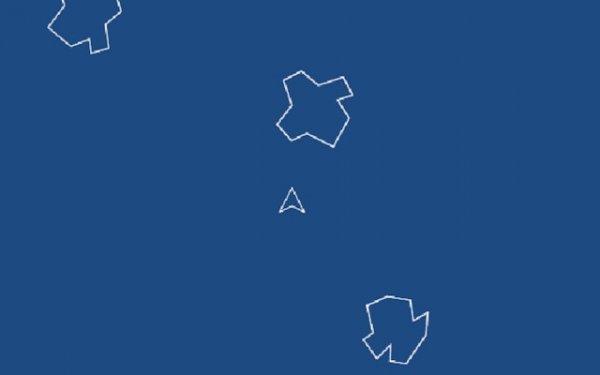
At its heart, this game revolves around a simple but demanding cycle. You control a small ship in a 2D playfield filled with slowly drifting space rocks of various sizes. Your primary tool is a laser that can break these rocks into smaller pieces. Each fragment moves faster and is harder to avoid, creating a constant escalation of risk. Alien saucers appear periodically, adding a second layer of threat. The goal is to clear the field while keeping your ship intact. Every successful run builds toward a higher score, with no checkpoints or saves—just you and the growing chaos.
Visual Style & Atmosphere
The presentation deliberately echoes the look of early arcade cabinets. Ships and rocks are rendered as clean, geometric shapes against a deep black backdrop. There are no complex textures or lighting effects. Instead, the focus is on clarity and readability. Every object stands out clearly, making it easy to track movement even when the screen gets busy. The sound design follows the same philosophy, with simple blips and explosions that feel authentic to the era. This minimalist approach ensures the game runs smoothly on a wide range of devices, from older computers to modern tablets.
Difficulty Progression
The challenge ramps up naturally as you play. Early rounds feature a few large rocks that are easy to dodge and break apart. As you destroy more objects, the field becomes crowded with smaller, faster fragments. Alien saucers start appearing more frequently, and their aim improves. The pacing is designed to keep you on edge without feeling unfair. There are no sudden difficulty spikes. Instead, the pressure builds gradually, giving you time to adjust your strategy. This progressive difficulty makes each session feel rewarding, as you can see your own improvement over time.
Controls & Responsiveness
Precision is everything, and the controls are built to support it. The ship rotates left or right with a single key press, and a separate key fires thrusters to move forward. Another key fires the laser. The response is immediate, with no noticeable input lag. This direct control scheme means that every mistake feels like your own, not the game's. It also means that skilled players can perform complex maneuvers, like spinning while firing to clear rocks on all sides. The learning curve is gentle enough for newcomers but offers plenty of depth for those who want to master it.
Score System & Replayability
High scores are the main driver for replay. Each run ends when your ship is destroyed, and your final score is recorded. The game may include an online leaderboard, allowing you to compare your best efforts with other players around the world. Because the field is procedurally generated, no two runs are exactly alike. This randomness, combined with the skill-based scoring, encourages repeated play. You will find yourself saying 'just one more try' as you chase a new personal best. The short session length makes it easy to pick up for a few minutes, but the pursuit of a higher score can keep you playing for much longer.





Player comments
Sign in to comment
You must be logged in before posting a review or rating.
No account? Create one
No comments yet. Be the first to comment!